
Fantasy does not require someone from modern Japan to arrive in another world. A story can begin among people who already belong to its setting and let the audience discover that place through their work, loyalties, and assumptions.
These selections offer different forms of that discovery. None needs another anime first. Several are incomplete adaptations, so the table distinguishes an entry point from a finished source story.
Choose what makes a world interesting to you
| Title | Strongest route in | Starting commitment | Limitation |
|---|---|---|---|
| Moribito: Guardian of the Spirit | Protection, politics, and everyday survival | 26 episodes | Adapts one novel’s central story, not the whole novel sequence |
| Delicious in Dungeon | Ecology, food, and party relationships | 24-episode first season | The season does not finish the manga |
| Frieren | Travel, memory, and changing perspective | 28-episode first season | A starting installment, not the whole journey |
| Land of the Lustrous | Identity in an unfamiliar society | 12 episodes | Stops well before the source ending |
| Ranking of Kings | Power, vulnerability, and conflicting loyalties | 23-episode main season | A substantial arc rather than the entire source |
Moribito for a lived-in society
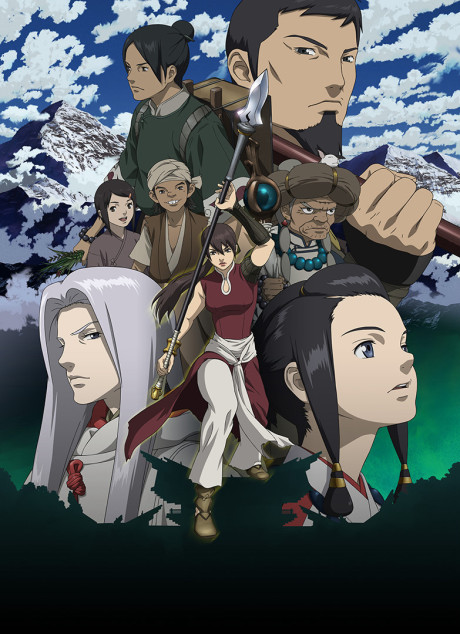
A protector’s work introduces a society with its own responsibilities and beliefs.
A bodyguard protecting a prince gives the story a clear immediate task, but protection requires food, shelter, trust, and knowledge of local institutions. Those practical needs make the world feel inhabited. Political and spiritual understandings of the same situation do not necessarily agree.
Choose it for an adult lead and a careful balance of action with everyday life. Its 26 episodes adapt the central story of the first novel in a larger sequence, giving this installment a stopping point. The deliberate pace may disappoint someone looking for rapid power increases and frequent spectacle.
Delicious in Dungeon for a world whose creatures matter

Survival depends on understanding how the world and its creatures fit together.
The party’s need to eat turns monsters into more than enemies to defeat. Their habits and relationships affect how the dungeon works. Food also brings differences between party members into ordinary, repeated contact.
The first season’s 24 episodes are an entry point to a longer adaptation, not a complete weekend story. Its comic surface gives way to darker and sometimes grotesque material. Choose it for ecological curiosity and ensemble friction; avoid it if food preparation, body horror, or tonal changes sound unwelcome.
A world can feel new without its hero being new to it.
Frieren for the time between large events
The aftermath of an adventure can change how the adventure itself is understood. Frieren uses travel and encounters to revisit the meaning of relationships across different lifespans. Its strongest appeal is often the attention given to what a more hurried fantasy would pass over.
Start with the original 28-episode season, while recognising that later installments continue the adaptation. There is action, but it is not a promise that every episode will build toward a larger battle. Our Frieren alternatives separate that reflective appeal from the combat and party elements.
Land of the Lustrous for unfamiliar personhood
An unusual society makes questions of usefulness, vulnerability, and identity visible in physical terms. The protagonist’s changing role matters because personal and bodily changes are difficult to separate. The setting asks for curiosity rather than immediate familiarity.
Its 12 episodes end long before the manga’s conclusion. This is therefore the clearest mismatch for anyone whose main requirement is closure. Choose it for visual strangeness and an evolving sense of self, with the expectation of an incomplete adaptation and unsettling physical damage.
Ranking of Kings for appearance and power
A small, underestimated prince is an accessible starting point, but the story complicates easy assumptions about strength and allegiance. Its fairy-tale presentation gives characters an immediate visual identity while their motives become less simple.
The 23-episode main season develops a substantial arc. Later side stories and source material mean that this is not the entire fictional history. The childlike designs do not make it uniformly gentle: violence, cruelty, and family conflict matter. If you want reassurance more than danger, use the calm anime guide instead.
Sources and review
Factual references for this guide are listed below. Recommendation comparisons are Fantera’s editorial interpretation. See how we research and review articles.
- AniList catalogue reference: Moribito: Guardian of the Spirit
- AniList catalogue reference: Delicious in Dungeon
- AniList catalogue reference: Frieren: Beyond Journey’s End
- AniList catalogue reference: Land of the Lustrous
- AniList catalogue reference: Ranking of Kings
Published . Reviewed .