
Twelve episodes at about 24 minutes each comes to under five hours. That is a Saturday afternoon and a Sunday evening with room for meals, or one determined night if you skip the opening credits. The catch is that “12 episodes” on a listing tells you how long the season is, not whether the story stops. Plenty of one-cour shows end on a recruitment poster for a second season that never came.
Every series below finishes its own story inside 11 to 13 episodes. Some leave a door ajar for a film or a sequel, and where that matters it is spelled out. None of them asks you to have seen anything else first.
The safest weekend: Ping Pong the Animation

- 11 episodes
- complete story
A table-tennis series that is really about five players deciding what winning is for. Ends properly.
Explore animePeco is loud, lazy, and gifted. Smile is quiet, obedient, and possibly better. Ping Pong follows the two of them and three rivals through one high-school season, and the matches are staged like arguments rather than highlight reels. Masaaki Yuasa’s direction splits the screen into comic panels, stretches faces into rubber, and lets a rally run long enough that you feel a player’s knees give.
The line drawings put some people off in the first five minutes. Stay past the first match. By episode four the roughness reads as honesty, and the final two episodes land a conclusion that answers every question the show raised. Eleven episodes, one season, nothing else to buy.
Two that hit hard: Madoka Magica and ERASED

- 12 episodes
- complete story
- optional sequel film
Starts as a magical-girl show. Do not read anything about it beyond this sentence.
Explore animeMadoka Magica opens with pastel school uniforms, a talking cat-like creature, and a contract offer any wish you like in exchange for fighting witches. The third episode changes what kind of programme you are watching, and the remaining nine tighten around that change. The witch battles are collage animation, paper cut-outs and scribbles that look like nothing else on television, and they are as unsettling as the story needs them to be.
The 12 television episodes end. A 2013 film, Rebellion, continues the story, and you can decide about that afterwards. Content note: this is a show about teenage girls suffering, sometimes graphically, and the despair is the point.

- 12 episodes
- complete story
A man is thrown back into his 11-year-old body to stop a murder he failed to notice the first time.
Explore animeSatoru is 29, drawing manga nobody buys, when a jolt of time sends him back to the winter of 1988 and a classmate named Kayo who always wears long sleeves. ERASED spends most of its episodes on that winter: walking Kayo home, lying to teachers, trying to change one child’s life with a child’s resources. The suspense comes from Satoru being certain what happens next and unable to make adults listen.
It resolves in 12 episodes, and the anime’s ending differs from the manga’s, which is worth knowing only if you plan to read it afterwards. Content note: child abuse and the murder of children are central, shown with restraint but never softened.
A short season is a fact about the schedule. A short story is a fact about the writing.
Two that stay warm: A Place Further and Tsukigakirei

- 13 episodes
- complete story
Four teenage girls talk their way onto a civilian Antarctic expedition. The trip happens.
Explore animeMari has never done anything with her life and knows it. Shirase has a million yen in savings and a mother who did not come back from Antarctica. The first half is logistics: passports, a job at a convenience store, a tearful farewell nobody asked for. The second half is the ship, the ice, and a sequence involving an unread inbox that makes grown adults put the remote down.
Thirteen episodes, and the expedition finishes within them. The tone is bright and the show is funny, but grief drives the last third. Choose it when you want to feel something and still sleep.
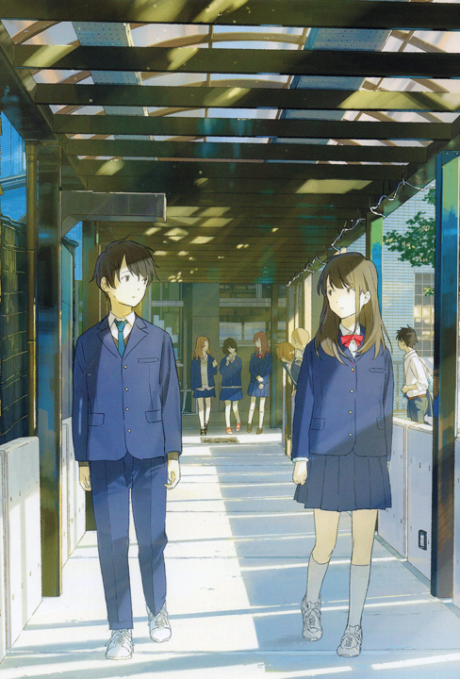
- 12 episodes
- complete story
Two third-years at a Japanese middle school fall in love mostly over a messaging app. It ends with an answer.
Explore animeKotaro writes novels in secret. Akane runs track and squeezes a stress-relief mascot in her pocket. Tsukigakirei watches them exchange messages, delete messages, and fail to speak at a school festival, and it treats each of those as an event. Nothing else on this list is this gentle, and the final episode does something with time that is rare for a school romance: it tells you how things turn out.
A recap special sits between episodes in some listings and can be skipped. If this one lands, the romance guide has more shows where the relationship actually moves.
Two with a bigger machine: ODDTAXI and Vivy

- 13 episodes
- central mystery resolves
- follow-up film
A walrus drives a taxi around Tokyo. A girl is missing. Everyone who gets in the cab is lying about something.
Explore animeOdokawa is a 41-year-old taxi driver who does not like people, and the show is built from his fares: a comedy duo going nowhere, a college student obsessed with a viral post, an idol trio, a gangster. ODDTAXI is animal-headed and low-key for a long time before you realise how many small remarks were evidence. The 13 episodes close the missing-girl case and then, in the last minute, add one more worry.
A 2022 film, In the Woods, recuts the series with new scenes. You do not need it for the ending. Listen closely; the dialogue is the plot.

- 13 episodes
- approx. 308 minutes
- complete mission
A singing android gets a hundred-year mission from the future. Big fights, real consequences, and it finishes.
Explore animeVivy is the first autonomous AI in a theme park, built to sing, when a cube-shaped visitor from a century ahead tells her that AIs will one day kill everyone. Each arc jumps years forward, so the choices she makes in one episode have hardened into history by the next. Wit Studio’s action is clean and heavy, and the show is not shy about killing characters you liked.
The official set lists 13 episodes at about 308 minutes, and the central mission ends within them. Content note: violent deaths, including of people who were kind. The two-part opening is the slowest stretch; it pays off.
Hours per pick
| Series | Episodes | About | Mood | Mind the |
|---|---|---|---|---|
| Ping Pong the Animation | 11 | 4¼ hours | Bruising, funny, hopeful | Unconventional drawing |
| Puella Magi Madoka Magica | 12 | 4¾ hours | Sweet, then not | Graphic despair, teenage deaths |
| ERASED | 12 | 4¾ hours | Tense, protective | Child abuse, murder |
| A Place Further Than the Universe | 13 | 5 hours | Warm, tearful | Bereavement |
| Tsukigakirei | 12 | 4¾ hours | Quiet, tender | Very little happens on purpose |
| ODDTAXI | 13 | 5 hours | Dry, sly | A final-scene sting |
| Vivy: Fluorite Eye’s Song | 13 | 5 hours 8 minutes | Loud, sad | Violent deaths |
The short-season trap
Some of the best-loved 12-episode shows are the first quarter of something: Frieren’s 28-episode first season is not the story, and a dozen shounen hits stop at “to be continued” while the manga runs on. Our seasons and cours explainer shows how to read a listing before you commit, and the completed anime guide collects longer stories that reach a real ending. If you have only one evening, a standalone film is the honest answer.
Sources and review
Factual references for this guide are listed below. Recommendation comparisons are Fantera’s editorial interpretation. See how we research and review articles.
- Vivy -Fluorite Eye's Song-: official Blu-ray listing (13 episodes, approx. 308 minutes)
- Puella Magi Madoka Magica: official portal
- ODDTAXI: official site
Catalogue entries
Episode counts, years, and studios come from Fantera’s AniList-derived catalogue.
- Ping Pong the Animation (11 eps · 2014) · AniList
- Puella Magi Madoka Magica (12 eps · 2011) · AniList
- ERASED (12 eps · 2016) · AniList
- A Place Further Than the Universe (13 eps · 2018) · AniList
- Tsukigakirei (12 eps · 2017) · AniList
- ODDTAXI (13 eps · 2021) · AniList
- Vivy -Fluorite Eye's Song- (13 eps · 2021) · AniList
Published . Reviewed .