
In Fantera’s September 14, 2026 catalogue snapshot, the median episode count among eligible finished television entries was 13. That is a fact about this sample of database entries, not a claim that the typical complete anime story lasts 13 episodes.
The distinction matters because separate seasons can have separate entries. A viewer following a story across several seasons will spend much longer than the count beside its first entry suggests. This study measures the release units the catalogue records.
The result at a glance
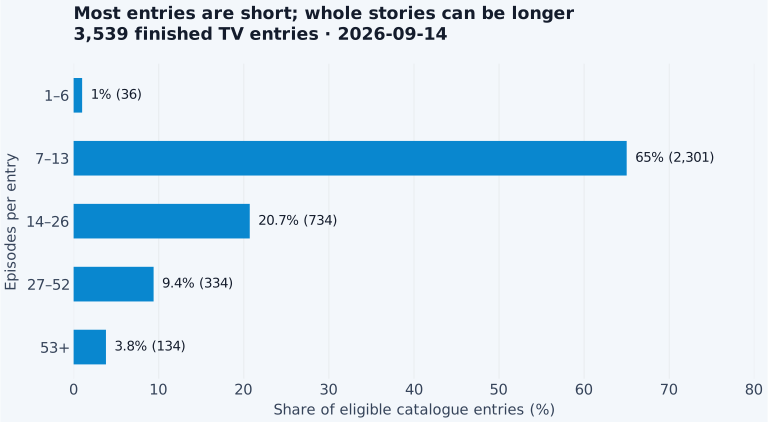
| Episodes per eligible entry | Number of entries | Share of sample |
|---|---|---|
| 1–6 | 36 | 1.0% |
| 7–13 | 2,301 | 65.0% |
| 14–26 | 734 | 20.7% |
| 27–52 | 334 | 9.4% |
| 53 or more | 134 | 3.8% |
Percentages are rounded independently, so they need not sum to exactly 100 percent. The median is the middle episode count after sorting all 3,539 eligible values. Each entry receives equal weight; a more popular show does not count more heavily.
What we measured
- 4,998 entriesThe full dated catalogue snapshot.
- 3,539 eligible entriesTV format, finished broadcast, known positive episode count.
- 13-episode medianThe middle entry count, not a whole-franchise length.
The source snapshot contains 4,998 AniList-derived catalogue entries. We retained entries whose format is TV, status is FINISHED, and episode count is a known positive integer. That leaves 3,539 eligible entries and excludes 1,459.
Restricting the sample to finished broadcasts avoids treating an announced or still-changing episode count as a completed run. It does not establish that the underlying manga or narrative is complete. Films, online-only entries, OVAs, specials, and other formats are outside this particular calculation.
We chose transparent episode-count bands that distinguish very short runs, roughly one-cour runs, longer installments, and long-running entries. They are descriptive categories rather than a model claiming those boundaries determine how a story feels.
We counted catalogue entries. A viewer commits to a story.
What a viewer can take from it
Short individual TV entries are common in this catalogue: the 7–13 band contains 65.0 percent of the eligible sample. That supports making short-entry filters easy to use. It does not support labelling every result in that band as a self-contained weekend story.
For example, Mob Psycho 100’s main seasons have separate counts of 12, 13, and 12. A season-level measurement can correctly place each within a short band while a whole-story commitment is 37 episodes. Our season terminology guide explains that practical difference.
Likewise, a catalogue entry for a film may contain an episode count of one. We excluded films rather than silently treating that one as a short television episode. Runtime is a separate measurement and is not collected in the snapshot used here.
What this sample cannot establish
Fantera’s catalogue is selected through its sync process rather than a random survey of every anime ever made. Discovery and inclusion criteria can shape the observed distribution. This is not evidence that 65 percent of all anime stories have one-cour length.
Separate sequels, seasons, and alternate versions can each contribute entries. We did not collapse franchises or infer required viewing order. We also did not verify narrative completion for every row, compare genres statistically, or estimate how long an actual viewer would take including breaks.
Those limits are reasons to use the result carefully, not reasons to discard the measurement. It answers a narrower, useful question: what episode counts does this version of Fantera’s finished-TV catalogue present to a user?
Reproduce or reuse the calculation
Download the snapshot CSV. Each row contains an AniList ID, format, episode count, and release status. IDs let a reader look up individual entries without redistributing full descriptions or artwork.
The repository includes the snapshot checksum, the source SQL checksum, the filter and summary function, and a command that verifies the saved report against the CSV. Run node --experimental-strip-types scripts/analyze-episode-counts.ts --check from the repository to reproduce the validation without a network request or a database change.
The chart and table describe this dated snapshot. Future catalogue changes should produce a new dated study rather than silently replacing the evidence behind these figures. For a recommendation that also verifies a stopping point, use our weekend selections or completed-story guide.
Sources and review
Factual references for this guide are listed below. Recommendation comparisons are Fantera’s editorial interpretation. See how we research and review articles.
- AniList API documentation
- Fantera: catalogue sync implementation
- AniList catalogue reference: Mob Psycho 100
- AniList catalogue reference: Mob Psycho 100 II
- AniList catalogue reference: Mob Psycho 100 III
Published . Reviewed .