Eighty-seven television episodes across four seasons and six broadcast parts, then two extended specials to close it out. Attack on Titan began in 2013 and needed a decade to end, and the show at the finish is barely the show at the start. Season one is a siege horror in which Eren Yeager watches a Titan eat his mother. The middle seasons are a paranoid thriller about which soldiers are lying and what the crown buried. The Final Season crosses the sea and asks you to look back at Paradis from the other side.
Few people love all of that equally, and your favourite stretch decides what to watch next. Find it in the table, then read the case for the pick.
Which part you loved
| If you loved | Watch | Commitment | The catch |
|---|---|---|---|
| Season one’s siege and dread | Parasyte -the maxim- | 24 episodes, complete | One town instead of a walled nation |
| The conspiracy in the middle seasons | Fullmetal Alchemist: Brotherhood | 64 episodes, complete | Jokes between the horrors |
| The Final Season’s war | Vinland Saga | 24 episodes, then a second season of 24 | Season two sets the sword aside |
| The wall, and who it keeps out | 86 EIGHTY-SIX | 11 + 12 episodes, story continues | A slow first half |
Vinland Saga, for a boy raised to kill

- 24-episode first season
- a second season of 24
- the story continues past the anime
A Viking boy spends years fighting for the man who killed his father, earning one duel at a time.
Explore animeThorfinn is a child when Askeladd kills his father, Thors, and he grows up inside Askeladd’s mercenary company, doing its dirty work in exchange for the right to challenge him. It is the Eren arrangement with the sentiment stripped out: a boy who has handed his whole personality to a grudge, and an adult who finds that useful. Askeladd is the best reason to watch. He is funny, patient, and the only person on screen who understands the Danish invasion of England as politics rather than a contest of who is hardest.
Wit Studio animated the first season, and they made Attack on Titan’s first three, so the battles carry a familiar weight. The London Bridge siege early on is the standout, with Thorkell, a giant who switched sides because the English offered a better fight, throwing logs at longships. The link to the Final Season sits underneath the action: can a person built for violence want anything else?
Vinland Saga answers that in its second season, 24 episodes that spend most of their time on a farm, and plenty of first-season fans walk away. Stay if the end of Attack on Titan left you thinking about the soldiers. Leave if you mainly came for the fights. Our full guide to anime like Vinland Saga goes further. Content notes: village massacres shown up close, and slavery.
86 EIGHTY-SIX, for the people outside the wall

- 11 episodes, then Part 2 for 12
- the light novels continue
A republic fights a war with drones and reports zero casualties. The drones have pilots, and the government has decided they are something less than people.
Explore animeThe Republic of San Magnolia tells its citizens that the war against the Legion, an army of autonomous machines, is fought by unmanned drones. Each drone is in fact piloted by an Eighty-Six, one of the minorities stripped of citizenship and walled into the country’s 86th Sector. Major Vladilena Milizé, Lena, commands a squadron by voice link from a spotless office in the capital. Its captain, Shinei Nouzen, has worn out several Handlers before her.
That is Attack on Titan’s structure turned sideways. Eren takes three seasons to learn what lies beyond the wall; 86 shows you both sides from the first episode and cuts between polished streets and scrap-metal barracks. The best thing in it is small. Lena insists on learning the pilots’ names, and the squadron’s surprise that anyone would ask tells you everything about the Republic.
The first half moves slowly, especially if mecha leave you cold, and the payoff comes late in the first cour. Part 2 ends at a real resting point, and the light novels carry on past it. Content notes: child soldiers, constant death in combat, and racial persecution as the premise.
Fullmetal Alchemist: Brotherhood, for the rotten state

- 64 episodes
- complete
Two brothers break alchemy's one law trying to bring back their mother, then join the army to fix their bodies and find out what the army is for.
Explore animeEdward Elric lost a leg and an arm, and his brother Alphonse lost everything but a soul bound to a suit of armour, in one night of alchemy gone wrong. To find a way back, Ed becomes a State Alchemist, a licensed weapon of the Amestris military. The deeper he digs into the Philosopher’s Stone, the more the country around him looks like Titan’s royal government: a nation organised around a secret its founders buried.
Titan’s middle seasons expose the rot through interrogations and a coup. Brotherhood builds it as a mystery over 64 episodes, with a war crime at its centre told by the soldiers who carried it out. Roy Mustang, Ed’s commanding officer, is the Erwin figure, a charming colonel climbing the chain of command for reasons he keeps to himself.
The mismatch is warmth. Brotherhood has running jokes about Ed’s height, a large cast who nearly all get a moment, and far more faith in people than Titan ever shows. It also has one of the most satisfying endings in long-form anime. There are two Fullmetal Alchemist series, and our comparison explains which to start with. Content notes: war atrocities, and an early body-horror episode involving a child and her dog.
Parasyte -the maxim-, for the horror of being food

- 24 episodes
- complete
Worms fall from the sky and take over human heads. The one that reaches Shinichi misses and settles for his right hand.
Explore animeShinichi Izumi wakes up with a parasite in his right hand. Others of its kind have replaced their hosts’ heads and started eating people; his only got as far as the wrist, so it needs him alive. He names it Migi, Japanese for “right”, and the two bargain their way through a town where the neighbours are quietly being swapped out.
This is season-one Titan kept at human scale: the knowledge that something shaped like a person wants to eat you, and the slow realisation that the monsters are getting organised. Migi is the reason to stay. It reads books to understand humans, has no instinct for sentiment, and asks the cold questions about survival that the Survey Corps only say out loud much later. Madhouse adapts the whole manga across 24 episodes, and the ending is an ending.
The electronic soundtrack has dated badly, and the school scenes are the weakest part. Content notes: graphic gore, and a family death shown on screen.
Attack on Titan spent a decade asking whether the people you cheered for were the monsters. Its best successors ask the same thing in a fraction of the time.
More, briefly

- 12 episodes
- the 2025 Reze Arc film continues it
Denji, a teenager crushed by his dead father's debts, merges with his chainsaw-dog Pochita and becomes a devil hunter.
Explore animeMAPPA, the studio behind Attack on Titan’s Final Season, made this in 2022, and it has the same appetite for killing characters you were starting to like. Denji dreams of bread with jam and a girlfriend, which makes him the anti-Eren: no cause, only appetite. The humour is crude and constant, so expect whiplash if Titan’s seriousness was the draw. It pairs naturally with anime like Jujutsu Kaisen. Content: extreme gore and sexual humour.
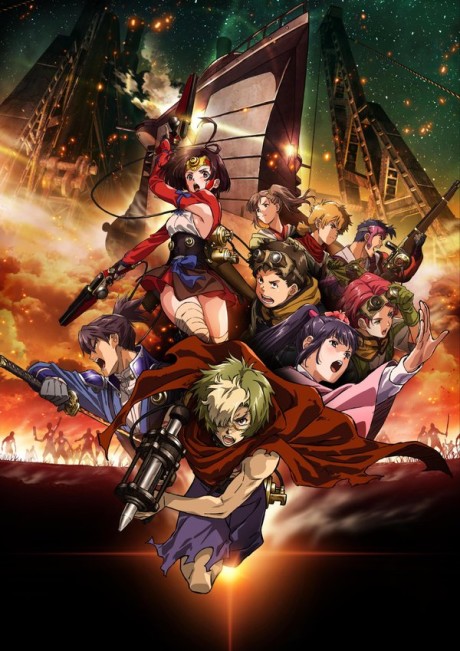
- 12 episodes
- the 2019 film The Battle of Unato continues it
In an industrial-age Japan overrun by the undead Kabane, a steam engineer builds a gun to pierce their iron-caged hearts.
Explore animeDirector Tetsuro Araki, Wit Studio and composer Hiroyuki Sawano came here after Attack on Titan’s first season, and the opening episodes are the closest thing to that season’s first act anywhere: fortified stations, an armoured train, and a massacre at the gates. Ikoma is Eren with a workshop, and Mumei fights like a gymnast. The writing loses its grip around the midpoint, so treat the back half as spectacle.

- 26 episodes
- the anime writes its own ending
Half-human women called Claymores hunt shape-shifting Yoma for an organisation that never explains itself.
Explore animeClare is ranked 47th of 47 warriors, which tells you how her employers value her, and she carries a revenge as fixed as Eren’s. The fights are sword-and-scream fantasy in a cold grey palette, and the Organization’s secrets unfold much like the walls’ do. Madhouse’s 2007 series breaks from the manga for its last episodes with an invented ending that feels rushed. Content: gore, dismemberment, and child abuse in flashback.

- 22 episodes
- a complete first season, sequels optional
In a Tokyo that scans every citizen for criminal intent, a rookie inspector starts asking what the scanner is.
Explore animeGen Urobuchi’s script puts Titan’s central suspicion, that the institution keeping you safe is built on something monstrous, into a police procedural. Akane Tsunemori is the rookie; Shinya Kogami, an enforcer who used to be an inspector, is the one to watch against Makishima, a villain who quotes philosophy while he works. The early case-of-the-week episodes are slower going. Content: graphic violence, including sexual violence.

- 13 episodes
- a film and a 12-episode second season continue
An orphan named Riko climbs down into a vast pit with Reg, a robot boy, to find her missing mother.
Explore animeMade in Abyss shares season-one Titan’s best trick, a world whose history is hidden and whose rules punish anyone curious enough to dig. Each layer of the Abyss has a curse that strikes on the way back up, from dizziness near the top to the loss of your humanity lower down. The characters look like they belong in a picture book, which makes the cruelty in the last episodes land harder. Content: graphic injury to children.

- 13 episodes
- a second season of 12 aired in 2026
Gabimaru, a ninja on death row, is promised a pardon if he brings back the elixir of life from a forbidden island.
Explore animeEach convict is shadowed by an executioner from the Yamada Asaemon clan, and Sagiri, the one assigned to Gabimaru, is the sharpest character in the show. The island is lush and pretty and full of creatures that turn people into flowers, which is the nearest this list gets to the Titans themselves: beautiful, uncanny and indifferent. MAPPA made it. Content: body horror and torture.

- 12 episodes
- stop after the first season
Emma, Norman and Ray are the brightest children at an orphanage with a gate nobody is allowed near.
Explore animeGrace Field House does for three orphans what Wall Maria did for Eren: a safe home that turns out to be a pen. The first season is a twelve-episode escape plan, and the matron, Isabella, is one of the best antagonists of its decade. The 11-episode second season abandons the manga’s story, and we would leave it alone. There is more in anime like Death Note. Content: children in danger throughout.
Before you start one
After ten years of waiting for Titan to finish, check the ending status. Brotherhood and Parasyte both close their stories cleanly, and so does Claymore in its own way. Vinland Saga, 86, Chainsaw Man and Hell’s Paradise all stop with more story to tell. Our anime with real endings list is the place to look if that matters.
If the fights were the draw rather than the politics, anime like Demon Slayer covers monster-hunting with more sword work and less despair. For a longer list sorted by catalogue similarity, open the Finder with Attack on Titan selected and read the reason under each result before you commit a month to it.
Sources and review
Factual references for this guide are listed below. Recommendation comparisons are Fantera’s editorial interpretation. See how we research and review articles.
Catalogue entries
Episode counts, years, and studios come from Fantera’s AniList-derived catalogue.
- Attack on Titan (25 eps · 2013) · AniList
- Vinland Saga (24 eps · 2019) · AniList
- 86 EIGHTY-SIX (11 eps · 2021) · AniList
- Fullmetal Alchemist: Brotherhood (64 eps · 2009) · AniList
- Parasyte -the maxim- (24 eps · 2014) · AniList
- Chainsaw Man (12 eps · 2022) · AniList
- Kabaneri of the Iron Fortress (12 eps · 2016) · AniList
- Claymore (26 eps · 2007) · AniList
- PSYCHO-PASS (22 eps · 2012) · AniList
- Made in Abyss (13 eps · 2017) · AniList
- Hell’s Paradise (13 eps · 2023) · AniList
- The Promised Neverland (12 eps · 2019) · AniList
Published . Reviewed .